
About
What is Sjögren’s Disease? Sjögren’s is a systemic autoimmune disease that affects the entire body. Along with symptoms of extensive dryness, other serious complications include profound fatigue, chronic pain, major organ involvement, neuropathies and lymphomas. Nine out of ten Sjögren’s patients are women, the average age of diagnosis is late 40s, although it can occur in all age groups.
The most common symptoms include dry eyes, dry mouth, fatigue and musculoskeletal pain. However, no two people have the exact same set of symptoms so Sjögren’s is often undiagnosed or misdiagnosed. The symptoms of Sjögren’s may mimic those of menopause, drug side effects, allergies, or medical conditions such as lupus, rheumatoid arthritis, fibromyalgia, chronic fatigue syndrome, and multiple sclerosis. Because all symptoms are not always present at the same time and because Sjögren’s can involve several body systems, physicians, eye care providers and dentists sometimes treat each symptom individually and do not recognize that a systemic disease is present.
Sjögren’s is serious but generally not fatal if complications are diagnosed and treated early. Sjögren’s patients must be monitored carefully for development of internal organ involvement, related autoimmune diseases and other serious complications. In particular, patients should be aware that the incidence of lymphomas (cancer of the lymph nodes) is significantly higher in people with Sjögren’s compared to the general population.
Are there clinical trials being conducted to improve comprehensive treatment for Sjögren’s? Research projects are ongoing and involve studying patients in a clinical setting to learn more about their symptoms, what treatments work and under what circumstances, and how best to improve quality of life.
The clinical manifestations most frequently used to date in randomized controlled trials (RCTs) in SjD include the biological, articular, glandular and cutaneous. As stated, the cutaneous manifestations are one of the manifestations resistant to change. Clinical manifestations used for rituximab and belimumab trials included constitutional, cutaneous and pulmonary; two of which are not sensitive to change. That categories of clinical manifestations insensitive to significant change were included in these trials leads to trial failure.
There is a need to address this issue to support future research.
Current Stage in the OMERACT Process
The group is preparing to launch a Delphi study to identify the most important domains for Sjögren’s disease, focusing on dryness, fatigue, and systemic features. Qualitative findings will soon be published.
Latest Update
Lightning Talk: In a rapid-fire session, our team shared an upcoming teaser of the Special Interest Group (SIG) session taking place during the conference.
👉 Watch the lightning talk here
Closing Plenary Talk: We were also featured in the Closing Plenary, where we highlighted the activities of the (SIG).
👉 Watch the presentation here
Looking Ahead
We are preparing to submit our qualitative work for publication while also drafting the protocol for our Delphi exercise. This two-pronged effort will advance both the dissemination of our findings and the consensus-building process required to establish a Core Domain Set.

Recent Publications
- DiRenzo DD, Ang L, O'Brien C, et al. OMERACT- determining a core domain set for Sjögren's disease: International focus group series. Seminars in Arthritis and Rheumatism 2026 Aug;79:153010. doi: 10.1016/j.semarthrit.2026.153010.
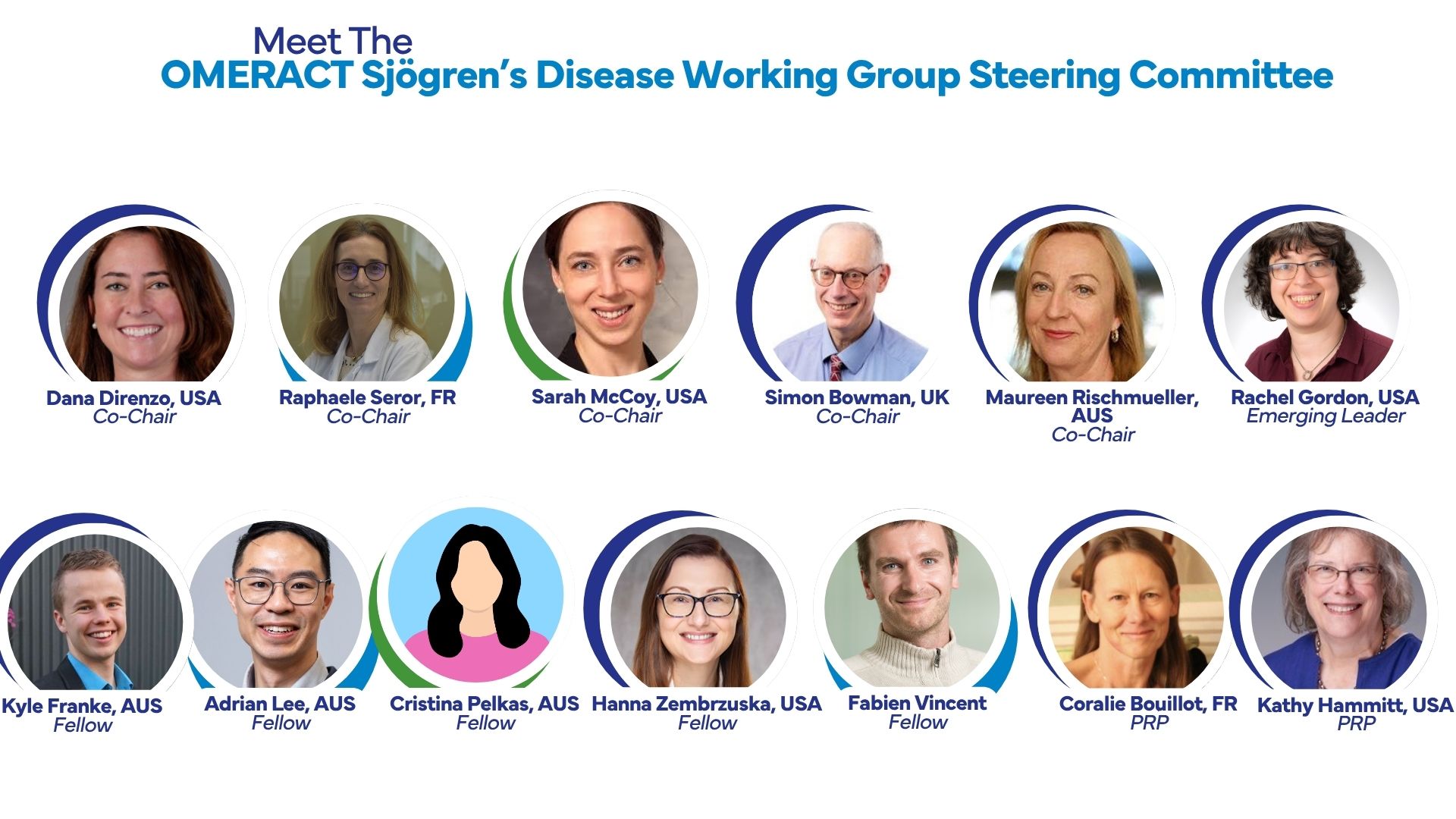
- Lee AYS, Zembrzuska H, Franke KB, Gordon R, Franke EF, Kumble L, Boderman B, Pelkas C, Hitchcock ME, Cornec D, Rischmueller M, Bowman SJ, Seror R, McCoy SS, DiRenzo D. "Patients' perspectives of living with Sjögren disease: A systematic review of qualitative studies from the OMERACT Sjögren disease working group." Seminars in Arthritis and Rheumatism 2026 Jan 22;77:152929. doi: 10.1016/j.semarthrit.2026.152929.
- Gordon, Rachael A., et al. “The Sjögren’s Working Group: The 2023 OMERACT Meeting and Provisional Domain Generation.” Seminars in Arthritis and Rheumatism, vol. 65, 152378, 2024, https://doi.org/10.1016/j.semarthrit.2024.152378.
- Nguyen, Yann, et al. “Identification of Outcome Domains in Primary Sjögren’s Disease: A Scoping Review by the OMERACT Sjögren Disease Working Group.” Seminars in Arthritis and Rheumatism, vol. 65, 152385, 2024, https://doi.org/10.1016/j.semarthrit.2024.152385.