
About
Calcium pyrophosphate deposition (CPPD) is due to calcium crystals depositing within joints. CPPD can lead to different forms of arthritis including an acute form (commonly known as pseudogout), where people experience acute episodes of joint pain and swelling, or a chronic form, where symptoms can last for a longer period. People with osteoarthritis can also develop CPPD. Not all people with calcium crystals in their joints experience symptoms.
Although CPPD is common, there has been very little research into this condition. Currently, there is no universally accepted way of reporting outcomes in studies of this condition.
Current Stage in the OMERACT Process
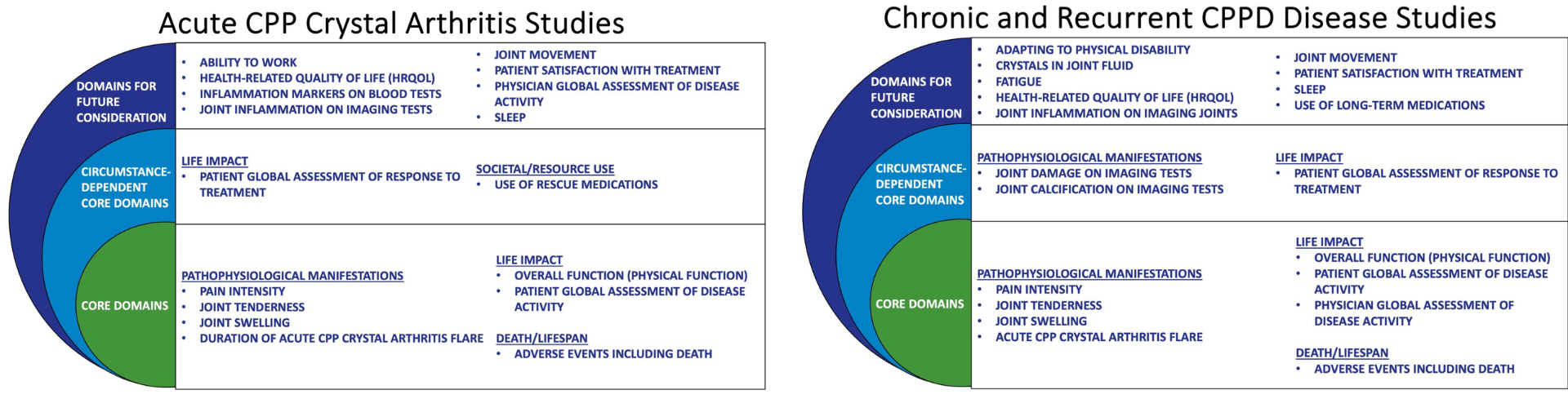
The CPPD Working Group has now received endorsement of its Core Domain Sets for acute and chronic/recurrent CPP crystal arthritis, and the manuscript has been submitted for peer review. With this milestone complete, the group is now beginning Instrument Selection Part A to identify candidate instruments for each core domain.

Core Domain Sets for Acute and Chronic/Recurrent CPP Crystal Arthritis Disease Studies
Recent Publications
- Zhang, Yiling, et al. “Core Domain Set for Studies of Acute Calcium Pyrophosphate Crystal Arthritis: OMERACT Delphi Survey to Establish Consensus.” Seminars in Arthritis and Rheumatism, vol. 72, 152670, 2025, https://doi.org/10.1016/j.semarthrit.2025.152670.
Cai, Ken, et al. “Outcome Domains Reported in Calcium Pyrophosphate Deposition Studies: A Scoping Review by the OMERACT CPPD Working Group.” Seminars in Arthritis and Rheumatism, vol. 50, no. 4, 2020, pp. 719–27, https://doi.org/10.1016/j.semarthrit.2020.05.015.
- Fuller, Amy, et al. “Experience and Impact of Crystal Pyrophosphate Deposition (CPPD) from a Patient and Caregiver Perspective: A Qualitative Exploration from the OMERACT CPPD Working Group.” Seminars in Arthritis and Rheumatism, vol. 51, no. 3, 2021, pp. 655–60, https://doi.org/10.1016/j.semarthrit.2021.04.010.
- Fuller, Amy, et al. “Outcome Domains Reported by Patients, Caregivers, Healthcare Professionals and Stakeholders for Calcium Pyrophosphate Deposition (CPPD): A Content Analysis Based on Semi-Structured Qualitative Interviews from the OMERACT CPPD Working Group.” Seminars in Arthritis and Rheumatism, vol. 51, no. 3, 2021, pp. 650–54, https://doi.org/10.1016/j.semarthrit.2020.09.021.
- Cai, Ken, et al. “Towards Development of Core Domain Sets for Short Term and Long Term Studies of Calcium Pyrophosphate Crystal Deposition (CPPD) Disease: A Framework Paper by the OMERACT CPPD Working Group.” Seminars in Arthritis and Rheumatism, vol. 51, no. 4, 2021, pp. 946–50, https://doi.org/10.1016/j.semarthrit.2021.04.019.