
About
Shoulder disorders, including rotator cuff disease (tendinopathy, impingement, subacromial bursitis, tears), adhesive capsulitis, instability, glenohumeral osteoarthritis, dislocation, proximal humeral or humeral head fractures, and unspecified shoulder pain, are highly prevalent disorders (7–26%), and are associated with significant morbidity, disability, and economic burden. Despite increasing numbers of trials investigating the benefits and harms of treatments for these disorders, there is as yet no widely endorsed core domain set (for outcome domains) or core outcome measurement set (for instruments) that is advocated for clinical trials. The Outcome Measures in Rheumatology (OMERACT) Shoulder Working Group was established in 2015 to develop these sets for clinical trials of shoulder disorders addressing all types of interventions.
Current Stage in the OMERACT Process
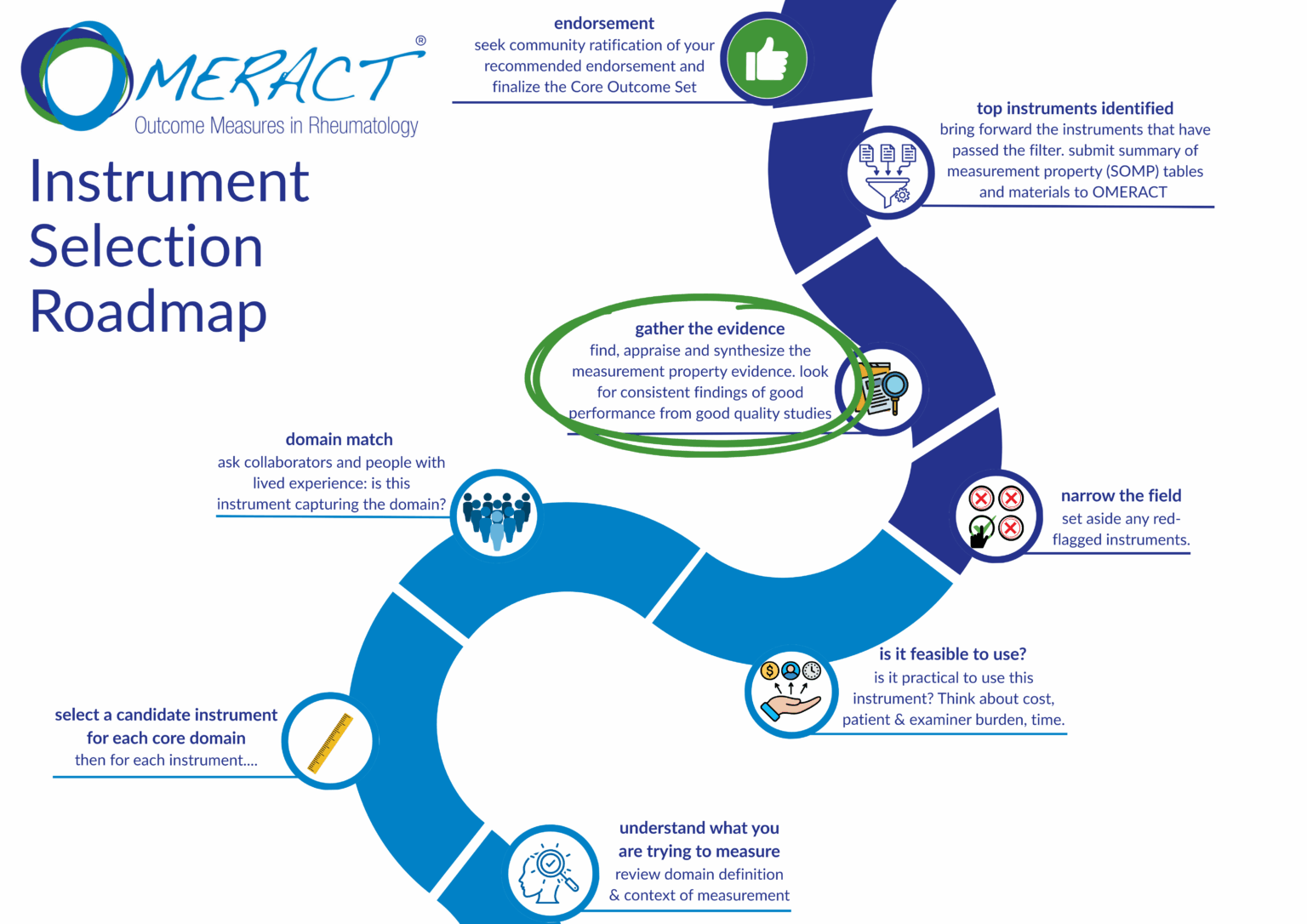
The group is finalizing evaluation of the NPRS and Oxford Shoulder Score using OMERACT methods. Once reviewed, these instruments will move forward for ratification.
Latest Update
OMERACT 2025 Conference Highlights
Fellow Poster: Our OMERACT Fellows, Hana Marmura and Rochelle Furtado, presented posters summarizing the current state of our work, sparking excellent conversations about next steps and collaborations. View the poster here
Lightning Talk: In a rapid-fire session, our team shared an upcoming teaser of the Special Interest Group (SIG) session taking place during the conference. Watch the lightning talk here
Closing Plenary Talk: We were also featured in the Closing Plenary, where we highlighted the activities of the (SIG). Watch the presentation here

OMERACT Endorsed Core Domain Set for Shoulder Disorders

Recent Publications
- Haas, R.,et al. "Suitability of the Oxford Shoulder Score for measuring pain in clinical trials evaluating interventions for people with shoulder disorders according to the OMERACT filter 2.2." Seminars in Arthritis and Rheumatism 2026 Aug;79:152998. doi: 10.1016/j.semarthrit.2026.152998.
- Furtado, R., et al. "Suitability of the Numerical Pain Rating Scale for measuring pain in clinical trials evaluating interventions for people with shoulder disorders according to the OMERACT filter 2.2." Seminars in Arthritis and Rheumatism 2026 Jun;78:152954. doi: 10.1016/j.semarthrit.2026.152954.
- Ramiro, Sofia, et al. “The OMERACT Core Domain Set for Clinical Trials of Shoulder Disorders.” Journal of Rheumatology, vol. 46, no. 8, 2019, pp. 969–75, https://doi.org/10.3899/jrheum.181070.
- Page, Matthew J., et al. “Patients’ Experience of Shoulder Disorders: A Systematic Review of Qualitative Studies for the OMERACT Shoulder Core Domain Set.” Rheumatology (Oxford, England), vol. 58, no. 8, 2019, pp. 1410–21, https://doi.org/10.1093/rheumatology/kez046.
- Page, Matthew J., et al. “Outcome Reporting in Randomized Trials for Shoulder Disorders: Literature Review to Inform the Development of a Core Outcome Set.” Arthritis Care & Research (2010), vol. 70, no. 2, 2018, pp. 252–59, https://doi.org/10.1002/acr.23254.
- Gagnier, Joel J., et al. “Creation of a Core Outcome Set for Clinical Trials of People with Shoulder Pain: A Study Protocol.” Current Controlled Trials in Cardiovascular Medicine, vol. 18, no. 1, 336, 2017, https://doi.org/10.1186/s13063-017-2054-9.
- Page, Matthew J., et al. “Identifying a Core Set of Outcome Domains to Measure in Clinical Trials for Shoulder Disorders: A Modified Delphi Study.” Rheumatic & Musculoskeletal Diseases Open, vol. 2, no. 2, 2016, p. e000380, https://doi.org/10.1136/rmdopen-2016-000380.