
About
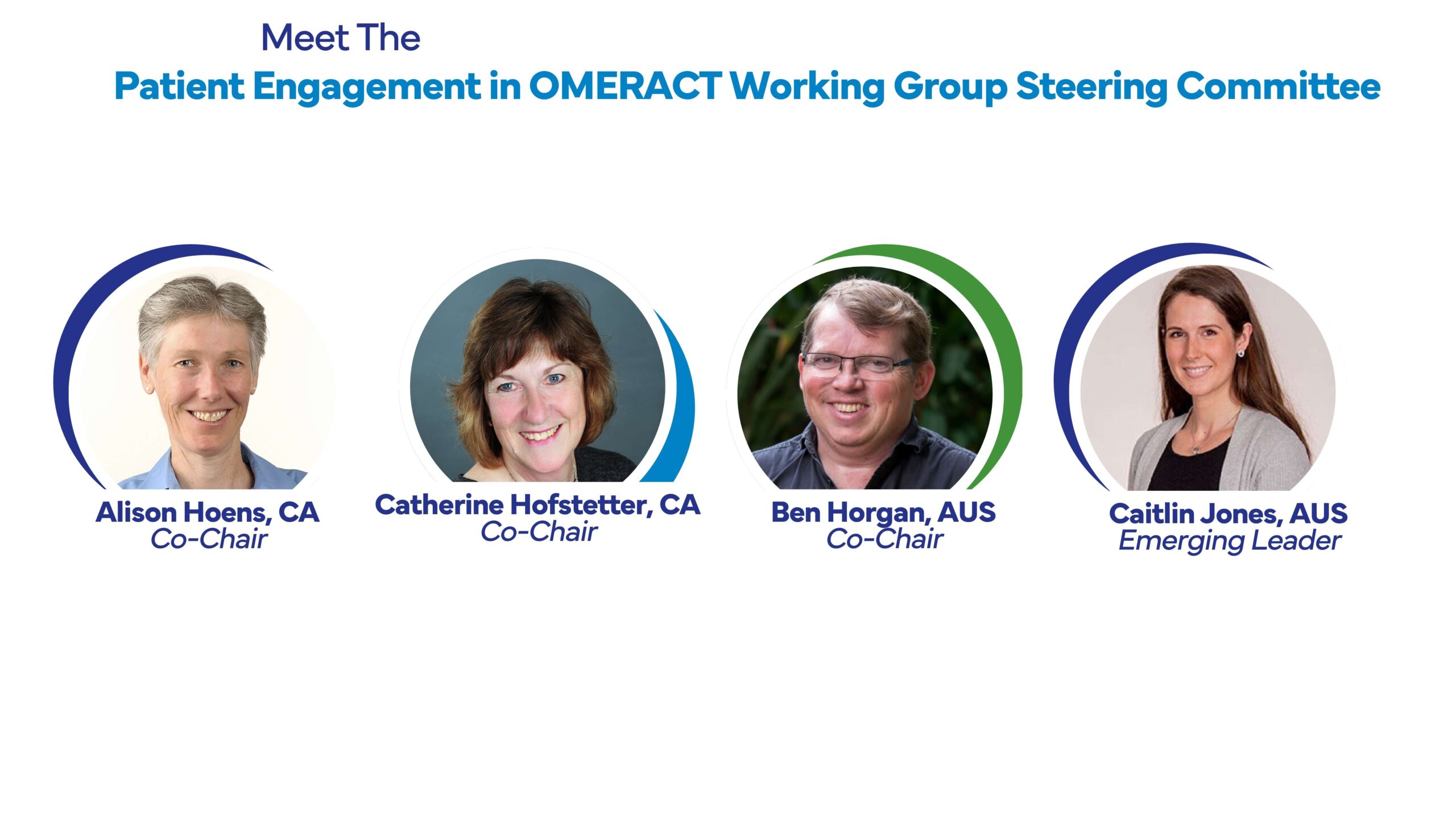
The Patient Engagement in OMERACT Working Group will focus on meaningful patient engagement across OMERACT Working Groups and OMERACT Core Outcome Set development processes by leveraging the Patient Engagement in Research (PEIR) Framework and the PEIRS-22 measurement tool. The team aims to ensure that Patient Research Partners (PRPs) actively co-create, advise, and make decisions alongside clinicians, methodologists, and other collaborators.
Why Patient Engagement Matters
-
Authentic Collaboration: Patients bring unique lived-experience insights that enrich Core Outcome Set development, and interpretation of results.
-
Improved Relevance: Engaging patients ensures that the outcomes we measure and the questions we ask truly reflect what matters most to people living with rheumatic and musculoskeletal conditions.
-
Shared Ownership: When patients serve as full partners, research becomes more transparent, accountable, and aligned with real-world needs.
Our Approach
Component |
Description |
|---|---|
PEIR Framework |
A dynamic model that defines the core domains of meaningful engagement—reciprocity, trust, mutual respect, and more. Introduced at OMERACT 2023 to guide our collaboration practices. |
PEIRS-22 Measurement |
A validated 22-item scale that quantitatively assesses the quality and depth of patient engagement, ensuring we can track progress and continuously improve. |
Objectives
-
Implement the PEIR Framework across all OMERACT working groups.
-
Educate researchers and patient research partners in PEIR principles and PEIRS-22 administration.
-
Measure PRP engagement using PEIRS-22 at key OMERACT checkin points.
-
Report findings annually to the OMERACT Management Group and broader community, highlighting successes and areas for growth.
-
Share best practices and lessons learned through webinars, publications, and conference sessions.
Current Stage in the OMERACT Process
The team is implementing the PEIR Framework and PEIRS-22 measurement tool across OMERACT projects. These initiatives strengthen meaningful patient engagement and guide continuous improvement.
Latest Update
OMERACT 2025 Conference Highlights
Plenary Talk: Our work was featured in one of the main plenary sessions at OMERACT.
👉 Watch the session here
Looking Ahead
The group will continue working through the OMERACT checklist for methods working groups, ensuring that patient engagement is fully integrated into methodological projects and working groups. We are also preparing resources to help working groups implement the PEIR framework in their work.

Recent Publications
- Hofstetter, Catherine, et al. “Patient Research Partner Engagement in OMERACT: Enhancing Engagement through the Implementation of Patient Engagement in Research Tools.” Seminars in Arthritis and Rheumatism, vol. 67, 152447, 2024, https://doi.org/10.1016/j.semarthrit.2024.152447.
- Jones, Caitlin, et al. “Implementing the PEIR Framework and PEIRS-22 to Facilitate Improved and Sustainable Patient Engagement in OMERACT.” Seminars in Arthritis and Rheumatism, vol. 72, 152704, 2025, https://doi.org/10.1016/j.semarthrit.2025.152704.